
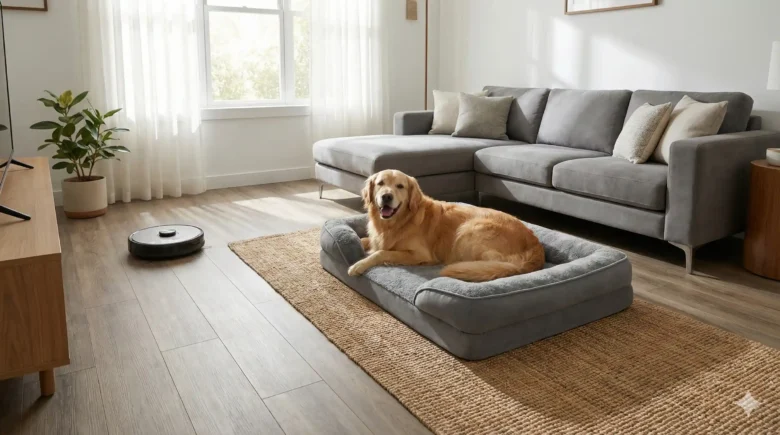
Let’s address the elephant in the room—or rather, the fluffy, energetic, golden-haired giant in your living room. There is a prevailing myth in the dog community that says: “You can have a Golden Retriever, or you can have a clean, stylish house. You cannot have both.”
For years, owners have resigned themselves to living in a state of “controlled chaos,” apologizing to guests for the tumbleweeds of fur in the hallway or the muddy paw prints on the beige carpet. But here is the truth: If your home feels chaotic, it’s not because your dog is “bad.” It’s because your home’s ecosystem hasn’t been optimized for its most active inhabitant.
At Top Curiosities, we believe that living with a Golden Retriever shouldn’t mean sacrificing your aesthetic or your hygiene standards. It simply requires a shift in mindset—from fighting against your dog’s nature to engineering a home that works with it.
This is not just a cleaning guide. This is an architectural approach to coexistence. By the end of this guide, you will transition from a stressed pet owner to a Curator of a Pet-Friendly Lifestyle, creating a space that protects your investment (your home) and enhances the longevity of your best friend.
Phase 1: The Foundation – Flooring and Joint Health
The most critical interface between your Golden and your home is the floor. This isn’t just about scratches on your hardwood; it is a medical issue. Golden Retrievers are genetically predisposed to hip dysplasia and joint issues. Slick surfaces (polished tile, hardwood, laminate) are the enemy. Every time your dog slips while rounding a corner, micro-traumas occur in their joints.
The “Traction Path” Strategy
You don’t need to cover your beautiful floors with cheap foam mats. Instead, think like an interior designer and create “Traction Paths.”
- Identify High-Velocity Zones: Watch your dog. Where do they run to greet you? Where do they drift when turning corners? These are your danger zones.
- Runner Rugs are Essential: Install high-quality runner rugs in hallways. This allows your Golden to accelerate and decelerate without engaging their “4-wheel drive,” which claws at your floor.
- The Anchor Rug: In the living room, a large area rug is non-negotiable. It creates a safe play zone.
Expert Tip: Avoid high-pile shag rugs. They trap dander and are impossible to deep clean. Opt for low-pile, tightly woven rugs. If you are renovating, look for Luxury Vinyl Plank (LVP) flooring with a textured finish—it is waterproof, scratch-resistant, and provides better grip than wood.
The Claw Protocol
Your floor’s worst nightmare isn’t the dog; it’s the neglect of the nails. Long nails act like skates on a hard floor, reducing traction and increasing damage.
- The Click Test: If you hear clicking when your Golden walks, the nails are too long.
- The Routine: Grind (don’t just clip) nails weekly. A smooth, rounded tip glides over floors rather than digging into them.
Phase 2: The “Particle Management” System (Handling the Fur)
A Golden Retriever has a double coat. They don’t just shed; they “blow coat” twice a year and shed moderately every other day. Trying to sweep this up manually is a losing battle. To maintain a pristine home, you must automate the process.
Passive vs. Active Cleaning
You need a system that works while you are sleeping.
- The Robot Sentry (Passive): Invest in a robot vacuum specifically rated for pet hair. It needs to run daily. The goal isn’t to deep clean; it is to prevent the accumulation of fur that eventually migrates to your furniture and clothes.
- The HEPA Defense: Fur is visible, but dander is invisible. Place a HEPA Air Purifier in the main living area. It captures airborne allergens before they settle as dust. This keeps your home smelling like a home, not a kennel.
Source Control (Grooming as Hygiene)
Think of grooming not as “beauty,” but as “home maintenance.” Every hair you remove with a brush is one less hair on your sofa.
- The 10-Minute Rule: spend 10 minutes brushing your Golden outside every other day.
- The Right Tool: Use an undercoat rake during shedding season. CAUTION: Do not shave your Golden. Their coat regulates their temperature and protects their skin. Shaving them ruins the texture and actually makes the shedding stickier and harder to clean.
Phase 3: Golden-Proofing Your Furniture
Golden Retrievers are “Velcro dogs.” They want to be where you are. If you are on the sofa, they want to be on the sofa. You have two choices: train them to stay off (difficult and sad) or adapt the furniture.
Performance Fabrics Over Leather
Leather scratches easily with big paws. Loose-weave linen traps hair like a magnet. The solution? Performance Fabrics.
- Crypton or Microfiber: These tight-weave synthetic fabrics are resistant to stains, odors, and punctures.
- Color Theory: Avoid black (shows light dust) and white (shows mud). A textured grey, taupe, or camel color blends with your dog’s shedding, making the home look cleaner between vacuums.
The “Decoy” Strategy (Mental Enrichment)
Goldens often destroy furniture or chew baseboards out of boredom, not malice. They are working dogs without a job.
- The Boredom Box: Instead of leaving toys scattered (clutter), keep them in a designated bin.
- Edible Pacifiers: When you want to relax on the sofa, give your dog a frozen Kong or a long-lasting chew on their designated bed. This redirects their chewing instinct away from your coffee table legs.
Phase 4: The Decompression Zone (Sleep & Territory)
A chaotic dog often lacks a “safe place.” If your dog paces around the house, it’s because they don’t have a defined territory.
The Orthopedic Necessity
Do not buy the cheap, fluffy beds from the discount store. A Golden Retriever weighs 65-75 lbs. Cheap filling flattens in a week, leaving your dog sleeping on the hard floor (see Phase 1 regarding joints).
- Memory Foam is Mandatory: Look for a 4-inch thick solid memory foam bed. It supports their hips and elbows.
- Placement: Place the bed in a low-traffic corner of the living room. This allows them to observe the “pack” (family) without being in the way.
Expert Tip: Washability is key. Ensure the bed has a removable, waterproof liner. Goldens love water, and a damp dog on a foam mattress breeds mold and bacteria instantly.
Phase 5: The Mud Firewall (The Entryway)
The transition from “Outside” to “Inside” is where 90% of the mess occurs. You need a dedicated “Airlock” system at your door.
The Double-Mat Technique
- Outside: A heavy-duty scraper mat to remove large debris and mud chunks.
- Inside: A highly absorbent microfiber “shaggy” mat. These soak up water like a sponge.
The Towel Station
Keep a basket by the door with:
- Microfiber Towels: Cotton pushes water around; microfiber lifts it.
- Paw Wipes/Plunger: For muddy days, a paw washer cup (plunger style) removes grit that would otherwise scratch your floors.
- The Routine: No entry until paws are dry. If you make this a ritual from puppyhood, they will eventually lift their paws automatically upon entering.
Conclusion: The Art of Living Together
Designing a Golden-Proof home isn’t about covering everything in plastic. It is about empathy and engineering. By choosing the right materials, automating the cleaning, and respecting your dog’s biological needs for traction and comfort, you create a feedback loop of happiness.
Your floors last longer. Your home smells fresher. And most importantly, your Golden Retriever stays healthier and calmer.
You are no longer just a dog owner surviving the mess. You are the architect of a home where love and cleanliness coexist. That is the true “Golden Lifestyle.”
F
Is it really possible to have a 100% hair-free home with a Golden Retriever?
Realistically, no. A Golden Retriever is a living creature that sheds to regulate body temperature. However, the goal of the “Particle Management System” is to make the hair invisible in your daily life. By combining a daily robot vacuum cycle with weekly undercoat grooming, you can reduce ambient fur by up to 90%. If you find hair clumps in corners, your system needs adjustment, not your dog.
I am renovating my house. What is the absolute best flooring for a Golden?
If budget allows, Luxury Vinyl Plank (LVP) is the gold standard. Unlike hardwood, it is waterproof (immune to drool and accidents) and highly scratch-resistant. Unlike tile, it is warm and provides a slight “give” underfoot. Crucially, look for LVP with a “hand-scraped” or textured finish to provide maximum traction for your dog’s hips as they age.
My house still smells like “dog” despite cleaning. What am I missing?
The “dog smell” usually doesn’t come from the floor; it comes from soft surfaces trapping moisture and bacteria. The two biggest culprits are the dog’s bed and your own sofa. Ensure your Golden’s bed has a waterproof liner (to stop oils from seeping into the memory foam) and wash the cover weekly. For the room itself, invest in a HEPA air purifier to capture dander, rather than masking odors with sprays.
Can I train my Golden to stay off the furniture, or should I just buy covers?
You can train them, but Goldens are highly social “Velcro dogs” who bond through physical touch. Access to the sofa is often their way of bonding with the pack. The “Golden-Proof” philosophy suggests meeting them halfway: allow access, but protect the asset with high-quality throws or performance fabric covers. If you strictly forbid furniture, you must provide a high-value orthopedic bed right next to the sofa as a viable alternative.
Does this protocol work for Golden Retriever puppies?
The principles are the same, but the intensity differs. For puppies, the “Foundation Phase” (flooring) is critical because their joints are still forming. However, regarding furniture, puppies require stricter management (crates or pens) until they are fully potty trained and through their teething phase. Do not give a puppy free roam of the “Golden-Proof” home until they have earned that freedom.