You wake up, look out the window, and your heart sinks. The sky is dark grey, the rain is pouring sideways, and your weather app shows no sign of it stopping. Then, you hear it: the unmistakable thump-thump-thump of a Golden Retriever’s tail hitting the floor.
You live in an apartment. You have no backyard. And you are now trapped inside with a 70-pound sporting breed that was genetically engineered to retrieve waterfowl all day in the Scottish Highlands. The dreaded “apartment zoomies” are imminent. Your sofa, your rugs, and your downstairs neighbors are in grave danger.
Most pet parents panic in this scenario. They try to play an aggressive game of indoor fetch, which usually results in a broken lamp, slipped paws on hardwood floors, and a dog that is actually more overstimulated than before.
At Top Curiosities, we approach this differently. A rainy day is not a punishment; it is a golden opportunity (pun intended) for cognitive development. You see, a Golden Retriever’s energy isn’t just physical—it’s mental. Veterinary behaviorists agree that 15 to 20 minutes of intense mental stimulation can drain a dog’s energy just as much as a one-hour run in the park.
In this definitive guide, we are going to transform your living room into a high-level canine enrichment center. We will shift your approach from physical exhaustion to psychological satisfaction. By the end of this protocol, your Golden Retriever won’t be bouncing off the walls; they will be snoring peacefully on their bed, giving you the quiet afternoon you deserve.
Phase 1: The Olfactory Protocol (Nose Work)
A Golden Retriever’s brain is dominated by its olfactory bulb. While humans process the world primarily through sight, your dog processes the world through smell. Sniffing is not just a casual activity for them; it is a highly demanding neurological workout. When you force your dog to use their nose, you are rapidly burning through their excess energy reserves.
The “Towel Burrito” Strategy
This is the ultimate entry-level brain game that requires zero expensive equipment—just an old bath towel and your dog’s regular kibble.
- Lay it Flat: Spread a large bath towel completely flat on your apartment floor.
- Sprinkle the Payload: Scatter a handful of highly aromatic treats or their daily kibble across the towel.
- The Roll and Tie: Tightly roll the towel up, trapping the food inside. For an advanced challenge, tie the rolled towel into a loose knot.
- The Execution: Present the “burrito” to your Golden. They will have to use their nose, paws, and teeth to unroll, untie, and scavenge for every last piece. This mimics the natural foraging behavior of their wolf ancestors and requires intense focus.
The Advanced “Find It” Game (Room Mapping)
If your dog has mastered the towel, it’s time to turn your entire apartment into a search-and-rescue grid.
- Step 1: The Command: Put your Golden in a “Sit-Stay” in the bathroom or hallway where they cannot see the living room.
- Step 2: The Hiding Spots: Take 5 to 10 high-value treats (like freeze-dried liver or small pieces of cheese) and hide them around the room. Put one under a couch cushion, one behind a curtain, one on the bottom shelf of a bookcase.
- Step 3: The Release: Walk back to your dog and enthusiastically say, “Find it!”
- The Result: Watch them methodically sweep the room. Their breathing will deepen as they inhale scents, and you will physically see their brain working to triangulate the location of the treats. Ten rounds of this will leave a young dog pleasantly exhausted.
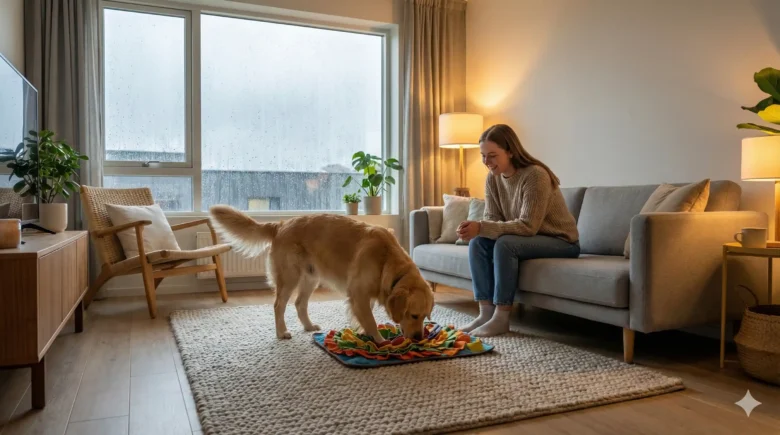
Expert Tip: Never use your dog’s regular food bowl on a rainy day. Every meal is a missed opportunity for mental work. Invest in a high-quality Snuffle Mat—a fabric puzzle that mimics tall grass, forcing your dog to sniff out their breakfast. It turns a 30-second meal into a 15-minute brain-draining puzzle.
Phase 2: Interactive Puzzle Engineering
Golden Retrievers are incredibly intelligent and eager to please. When they don’t have a “job” to do, they create their own jobs—like redesigning your baseboards with their teeth. To survive an indoor day, you need to employ mechanical puzzles that reward problem-solving.
The Layered Frozen Kong Technique
A classic rubber Kong toy is useless if you just throw some dry biscuits inside. The dog will empty it in two minutes and look at you for more. You need to build a “Kong Parfait” and freeze it.
- The Seal: Plug the small bottom hole with a dab of peanut butter (make sure it is xylitol-free!).
- The Core: Fill the middle with a mixture of plain greek yogurt, mashed bananas, and their regular kibble.
- The Cap: Seal the wide opening with wet dog food or pumpkin purée.
- The Freeze: Place it upright in the freezer for at least 4 hours.
- The Benefit: Licking releases endorphins in a dog’s brain, naturally lowering their heart rate and inducing a state of calm. A rock-solid frozen Kong will keep a 70-pound Golden occupied, silent, and mentally focused for up to 45 minutes.
High-Tier Cognitive Board Games
For the highly driven Golden, look into interactive wooden or plastic puzzles (like those designed by Nina Ottosson). These require the dog to slide blocks, press levers, and lift cups to reveal hidden treats.
- Start Easy: Begin with level 1 puzzles so they don’t get frustrated and try to just smash it with their heavy paws.
- Supervise: Always supervise board games in an apartment. The goal is focused interaction, not frustration. Guide them with encouraging words like “Good boy, try the other one.”
Phase 3: Micro-Obedience and Impulse Control
You don’t need a large backyard to practice obedience. In fact, the tight confines of an apartment are perfect for “Micro-Obedience”—hyper-focused, low-movement exercises that teach your dog impulse control. Impulse control is incredibly taxing on a dog’s nervous system; it burns massive amounts of mental calories.
The “Leave It” Gauntlet
Golden Retrievers are notorious vacuum cleaners; they want to put everything in their mouths. Practicing “Leave it” is an exhausting exercise in self-restraint.
- The Setup: Have your dog sit in front of you. Hold a low-value treat in a closed fist.
- The Test: Let them sniff your fist. They will likely lick or paw at it. Say nothing. Just wait.
- The Reward: The absolute second they pull their nose away and make eye contact with you, say “Yes!” and reward them from your other hand with a high-value treat.
- The Gauntlet: Progress to placing the treat on the floor, then on their paw. The mental effort it takes for a food-motivated Golden to stare at a piece of chicken and actively choose not to eat it is monumental.
Spatial Awareness and “Place” Training
Living in an apartment means your dog needs to know how to get out of the way gracefully. Use a rainy afternoon to perfect the “Place” command.
- The Target: Use their orthopedic bed or a specific mat.
- The Action: Lure them onto the mat and say “Place.” Reward them only when all four paws are on the mat.
- The Escalation: Once they are on the mat, ask for a “Down.” Now, start adding distractions. Bounce a ball, open the front door, or drop a piece of kibble. If they break the “Place,” reset them calmly. Holding a static position amidst chaos is pure mental weightlifting for a dog.
Expert Tip: Keep training sessions incredibly short. A Golden’s attention span for repetitive tasks drops off after about 5 to 10 minutes. Do three 5-minute sessions spread throughout the day rather than one frustrating 15-minute block. End on a high note, always.
Phase 4: Safe Indoor Physical Agility
While we are focusing heavily on mental stimulation, a young Golden Retriever still needs to stretch their muscles. However, traditional running or aggressive tug-of-war on slippery apartment floors (like laminate or tile) can tear a cruciate ligament or damage their hips. We need controlled physical exertion.
The Living Room Obstacle Course
Turn your furniture into a low-impact agility course. The goal here is proprioception (body awareness), not speed.
- The Crawl: Line up two dining chairs and place a broomstick across the bottom rungs. Use a treat to slowly lure your Golden to army-crawl underneath it. This engages their core and stretches their back.
- The Weave: Set up a row of five empty water bottles or throw pillows down the hallway. Put your dog on a short leash and use a treat to guide them in tight figure-eights around the obstacles.
- The Step-Up: Use a sturdy couch cushion or a specialized canine fitness peanut. Have them place only their front two paws on the unstable surface and hold the position. Balancing engages deep stabilizing muscles that regular walking ignores.
Structured “Floor Tug”
Tug-of-war is acceptable indoors, but only with strict rules to protect your floor and their joints.
- The Rule of the Rug: The game only happens on a carpeted area with good traction. If the dog steps off the rug, the game stops immediately.
- The “Drop It” Protocol: Use tug to practice emotional regulation. Let them get hyped up pulling the toy, then suddenly stop moving, freeze your body, and command “Drop it.” When they let go, reward them by immediately restarting the game. This teaches them how to transition from high arousal to calm focus in seconds.
Phase 5: The “Decompression Chew” (The Off Switch)
You have worked their nose, challenged their brain, practiced their obedience, and engaged their core. The storm is still raging outside, but your dog is now panting, satisfied, and thoroughly fatigued. Now, it is time to flip the “off switch.”
The Power of Mastication
Chewing is a dog’s natural way of self-soothing. The repetitive mechanical action of jaw movement releases serotonin and dopamine. However, giving them a cheap squeaky toy will just wind them back up. You need a long-lasting, edible chew.
- Bully Sticks & Yak Cheese: These are dense, single-ingredient chews that take a lot of effort to break down. They do not splinter like cooked bones (which are incredibly dangerous) and they last a long time.
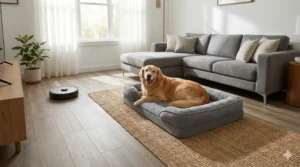
- The Isolation Protocol: Give your Golden their chew on their designated bed. This signals that playtime is officially over. The combination of physical fatigue from the agility, mental fatigue from the puzzles, and the soothing endorphins from the chew will inevitably lead to one thing: a deep, restorative nap.
Mastering the Indoor Ecosystem
Living in an apartment with a large, energetic sporting breed like a Golden Retriever is entirely possible, even when the weather conspires against you. The secret is simply shifting your perspective.
You cannot out-run a Golden Retriever. You cannot physically exhaust them by throwing a ball down a 15-foot hallway. But you can outsmart them. By engaging their olfactory senses, challenging their cognitive reasoning, enforcing impulse control, and utilizing the calming power of chewing, you drain their energy reservoir efficiently and safely.
A rainy day is no longer a prison sentence in your apartment. It is a scheduled day for bonding, training, and mental enrichment. You aren’t just surviving the storm; you are stepping up as a responsible, knowledgeable leader for your dog. So let it rain outside. Inside, you and your Golden have work to do.
FAQ: Tiring Out Your Golden Retriever in an Apartment
1. Is it really possible to tire out a Golden Retriever just by playing indoors?
Absolutely. Canine behavioral science shows that mental fatigue can be just as, if not more, exhausting than physical fatigue. Fifteen to twenty minutes of intense olfactory work (like using snuffle mats) or solving cognitive puzzles requires enormous concentration from your Golden Retriever, safely draining their energy without the need to run miles.
2. What are the safest and most effective toys for a rainy day in an apartment?
For indoor environments, you should avoid balls or fetch toys, as they cause sliding on smooth floors, which is detrimental to the breed’s joints. The best investments are environmental enrichment toys: Snuffle Mats (fabric foraging mats), durable rubber Kongs (to be stuffed and frozen), and sturdy plastic or wooden cognitive puzzles of intermediate level.
3. My Golden destroys interactive puzzles in minutes. What am I doing wrong?
Golden Retrievers have considerable jaw strength and tend to use their mouths to resolve frustration. If the puzzle is too difficult, they will try to break it rather than solve it. The secret is to always supervise the activity. Start with Level 1 puzzles, praise calm behavior, and remove the toy as soon as the dog starts trying to chew the material. For aggressive chewing, always opt for a frozen Kong or a high-quality Bully Stick.
4. Is playing tug-of-war inside the apartment bad for my dog’s joints?
Playing tug is excellent for bonding and teaching impulse control (the “Drop it” command), but it should only be practiced on a surface with traction, such as a thick rug or carpet. If the dog is slipping on laminate or tile floors while pulling, the risk of cruciate ligament injury or worsening hip dysplasia is extremely high. Keep movements at ground level and avoid pulling the dog’s neck upwards.
5. How do I calm my Golden Retriever down after an intense indoor play session?
The transition from high arousal to relaxation is crucial. Use the “decompression chew” technique. The continuous act of licking or chewing releases endorphins and actively lowers the animal’s heart rate. Guide your dog to their orthopedic bed (their safe zone) and offer them something long-lasting, like a safe chew or a frozen stuffed toy. This routine signals that playtime is over and naturally induces a deep sleep.