Let’s be honest for a second.
You looked at Instagram. You saw the fluffy, angelic golden clouds sleeping peacefully on a rug. You thought, “I need that kind of love in my life.”
So you got one.
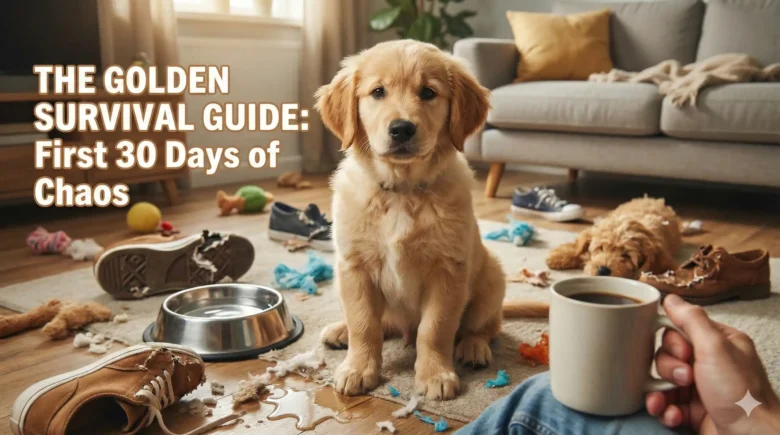
And now, three weeks later, you are looking at your chewed-up baseboards, you have band-aids on your hands from “play biting,” and you are Googling if it’s normal to cry over a puppy at 3 AM.
Welcome to the club.
The truth that breeders rarely tell you is that a Golden Retriever puppy is basically a Land Shark disguised as a teddy bear. They are intelligent, high-energy, and mouth-oriented.
But here is the good news: This chaos is temporary.
If you are reading this, you are in the “survival phase.” And this is your manual to reclaiming your house, your sleep, and your sanity—without losing the bond with your new best friend.
Phase 1: The “Anti-Destruction” Protocol (Saving Your Furniture)
Goldens don’t chew because they hate your sofa. They chew because they are Golden Retrievers. “Retrieve” is in the name. They explore the world with their mouths.
However, knowing why they do it doesn’t make it cheaper to replace a mahogany coffee table. Here is how to stop the bleeding (literally and financially).
Why They Chew (It’s Not Spite, It’s Physics)
Puppies have razor-sharp teeth for a reason, but between 3 to 6 months, they go through teething. Their gums hurt.
Chewing provides relief. If you don’t provide the “relief tool,” they will choose one for themselves. Unfortunately, they usually choose the most expensive item in the room.
The Texture Rule: Goldens love texture. If they are chewing your leather shoe, they want that specific “give.” Giving them a hard plastic toy won’t work. You need to match the texture.
The Swap Strategy: “Chew This, Not That”
Most new owners scream “NO!” and take the item away. This creates a vacuum. The puppy still needs to chew, so they will just find something else (like the drywall).
Use the 3-Second Redirect Rule:
- Catch them chewing the wrong thing.
- Give a low-tone interrupt noise (like “Ah-Ah!”).
- Immediately shove a high-value toy in their mouth.
- When they bite the toy, praise them like they just won the Nobel Prize.
Pro Tip: Rotate their toys. If all 20 toys are on the floor, they are boring. Keep 15 in a closet and swap them weekly. Ideally, invest in “indestructible” rubber toys that can be frozen. Cold rubber soothes the gums better than your table leg.
Housebreaking 101: The “No-Stain” Blueprint
Nothing devalues a home faster than the smell of dog urine soaking into the subfloor.
Goldens are smart (ranked 4th smartest breed), but they are not born knowing that your Persian rug isn’t grass.
The Crate is Your Best Friend (Not a Jail)
Many new owners feel guilty about using a crate. Don’t.
In the wild, dogs seek out small, dark dens for safety. A properly sized crate is that den. It is the single most effective tool for housebreaking because dogs naturally do not want to soil where they sleep.
- ** The Golden Rule of Sizing:** The crate should be big enough for them to stand up and turn around, but no bigger.
- If you buy a giant crate for a puppy, they will sleep in one corner and use the other corner as a bathroom. Use the “divider panel” that comes with wire crates to adjust the space as they grow.
The “Enzyme Secret” for Accidents
You will have accidents. It happens.
But here is the mistake 90% of owners make: Cleaning with bleach or standard household cleaners.
These cleaners remove the smell for your human nose, but for a Golden’s nose (which is 10,000 times stronger), the ammonia in the urine is still there. In fact, many standard cleaners contain ammonia, which actually encourages the dog to pee there again to “refresh” their mark.
The Fix: You must use an Enzymatic Cleaner. These are bio-engineered bacteria that eat the urine crystals. If you don’t break down the enzymes, that spot will forever be a “bathroom” in your dog’s mind.
The “Sleep Thief”: How to Get 6 Hours of Rest
If you look like a zombie at work, this section is for you. Goldens are social sleepers; they want to be near you. But they also have the bladder the size of a thimble.
The Exhaustion Equation
A tired dog is a good dog. But a physically tired Golden can often get “zoomies” (over-tired hyperactivity).
You need Mental Stimulation. 15 minutes of brain work is equal to 1 hour of running.
Instead of just walking them around the block, try:
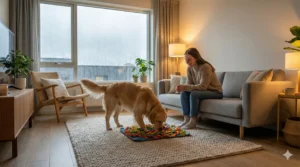
- Snuffle Mats: Hide dry food in a fabric mat. They have to use their nose to hunt.
- Frozen Kongs: Fill a rubber toy with wet food and freeze it. It takes them 30 minutes to lick it out. Licking releases endorphins that calm the dog down.
The Bedtime Ritual That Actually Works
Puppies thrive on routine.
- Cut water 2 hours before bed.
- The “Boring” Midnight Potty: When they cry at 2 AM, take them out on a leash. Do not talk. Do not play. Do not turn on bright lights. It is strictly business.
- The Heartbeat Hack: For young puppies recently separated from their litter, silence is terrifying. Use a plush toy that has a mechanical “heartbeat” inside. The rhythmic thumping mimics their mother and can help them settle in minutes.
The “Golden Tax”: Essential Gear vs. Waste of Money
You can spend a fortune on pet supplies. Half of it you will never use. Here is the “Golden Retriever Audit” of what is actually worth your credit card swipe.
Walkies Without Dislocated Shoulders
A 6-month-old Golden is strong. A standard collar puts all that pressure on their trachea (throat).
The Upgrade: A Front-Clip Harness. Instead of the leash attaching to the back (which triggers a “sled dog” pulling reflex), it clips to the chest. If they pull, the physics of the harness turns their body sideways, stopping the momentum instantly. It is power steering for your dog.
The Grooming Kit (Managing the Glitter)
We call it “Golden Glitter,” but it’s really just a ton of hair.
Don’t buy the cheap supermarket brushes. They just glide over the top coat. You need a Undercoat Rake or a de-shedding tool.
Goldens have a double coat. The undercoat is what sheds and creates tumbleweeds in your hallway. Brushing this out once a week is cheaper than buying a new vacuum cleaner every year.
Conclusion: They Grow Up Fast (Too Fast)
It feels like a struggle right now. The biting, the pee, the chewed shoes.
But one day, very soon, you will look down and that clumsy 15-pound ball of fluff will be a majestic, calm, 75-pound best friend resting their head on your knee.
The “Land Shark” phase is the price of admission for the years of loyalty you are about to receive. Take a deep breath. Buy the enzymatic cleaner. You’ve got this.
💡 Frequently Asked Questions
When do Golden Retriever puppies stop biting? Most Goldens stop the intense “puppy biting” between 5 to 6 months of age, once their adult teeth have fully come in. Consistent redirection to toys accelerates this process.
How long can a puppy hold their bladder? The general rule is: One hour for every month of age. A 2-month-old puppy can hold it for about 2 hours. This increases as they grow, reaching max capacity around 8-9 months.
Are Golden Retrievers high maintenance? Emotionally? No, they just want love. Physically? Yes. They require daily exercise, weekly brushing to manage shedding, and mental stimulation to prevent destructive boredom.